
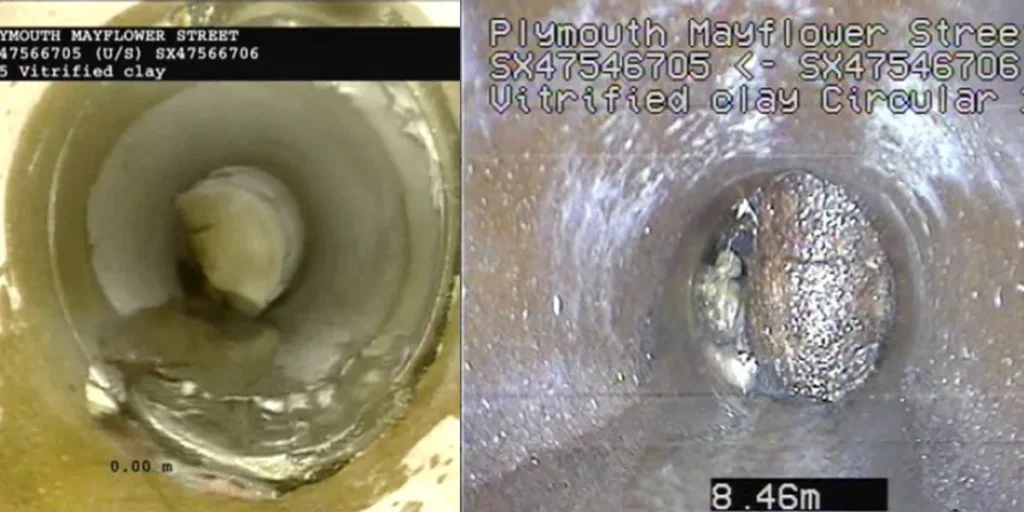
A steel pile driven 6.4m below a Plymouth bus station car park had punched through a live sewer and cut its cross-sectional area by 70%, flooding the commercial property above. Rather than divert the sewer at enormous cost and disruption, Exjet Services cut the pile out from inside the pipe using ultra-high-pressure abrasive water jetting — and had the car park back in use within five days.
| Location | Mayflower Street, Plymouth |
| Problem | Severe internal flooding of a commercial property |
| Cause | A structural steel pile penetrating the sewer 6.4m below a bus station car park, reducing the bore by 70% |
| Solution | Ultra-high-pressure abrasive water jet cutting, followed by PU patch repairs |
| Services used | CCTV sewer survey, high-pressure water jetting, no-dig patch repair |
| Duration | Pile cut and removed in three days; car park reopened within five |
The problem
Following a severe internal flooding event at a commercial property, Exjet Services were tasked with identifying the cause of the flooding and producing a viable solution to prevent a recurrence.
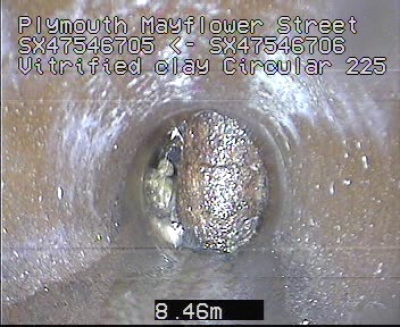
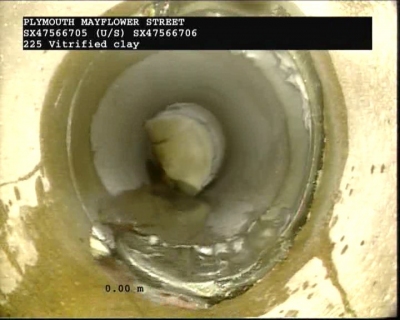
The initial investigation by CCTV survey revealed that a structural steel pile had penetrated the sewer at a depth of 6.4m beneath the bus station car park. It had reduced the sewer’s cross-sectional area by 70%.
Why the obvious answer was the wrong one
A number of options were considered. The client’s initial preference was to divert the sewer away from its original route and reconnect approximately 70m away. This was discounted: excavation would have been a high-risk operation given the excessive depth and the proximity to building foundations, with significant environmental impact, major cost, and disruption to business and the community.
On that basis, the client engaged Exjet Services to assess alternative solutions.
Scoping the cut
The outline brief required that the pile be removed to an extent where flow could be restored, that minimal damage be caused to the existing pipe wall, and that the pipe then be repaired by installing a CIPP liner or patch.
From the CCTV footage, the pile was estimated at 175–200mm diameter with a typical 8mm wall thickness. The age of the pile meant the reinforced concrete within it would have gained significant strength, so the cutting process had to guarantee removal of the pile, the concrete and any reinforcement steel — while ensuring the walls of the broken host sewer were not damaged further.
Managing Director Robin Dowell evaluated the use of ultra-high-pressure water jetting equipment, then adding an abrasive element (crushed garnet) to the jet to improve its cutting ability through both the pile and its core.
The innovation
One of Exjet’s suppliers was able to adapt a rotary cutting rig so that a 40,600 psi water jet could be directed and concentrated along a path following the internal profile of the host pipe. It was calibrated to a cutting depth of 210mm — enough to penetrate the full thickness of the steel pile and its concrete core — with flow rate limited to 20 litres per minute to prevent further damage to the host pipe. The method is also heat and spark free, which matters in a live sewer.
Delivery and outcome
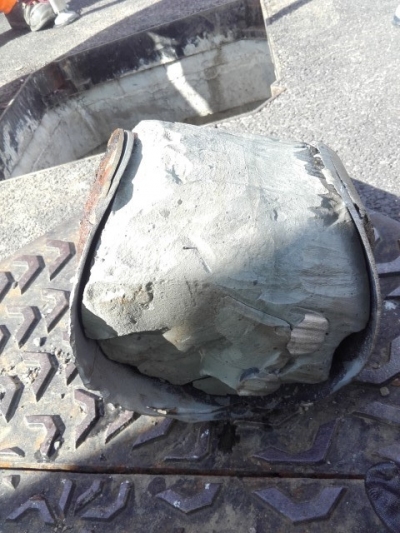
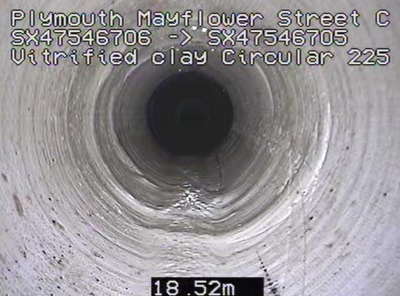
The pile was successfully cut and removed by Exjet over a period of three days, allowing the works to be completed with a number of PU patch repairs over the pile location. This restored the structural integrity of the pipe and allowed free flows to be re-established. The works were fully completed and the car park returned to use within five days.
Complex no-dig repairs like this sit within our commercial drainage services and our drainage services in Plymouth.
Talk to us about a similar problem
Exjet Services has been solving drainage and sewer problems across Devon, Cornwall, Somerset and Dorset since 1986, with commercial and planned work right across the South West. Our engineers are directly employed and we are certified to ISO 9001, ISO 14001 and ISO 45001.
If you have a drainage problem that nobody has been able to diagnose, get in touch or ring 0800 328 6655 — answered any hour.