
Septic Tank Discharge Regulations
What Is a Septic tank?
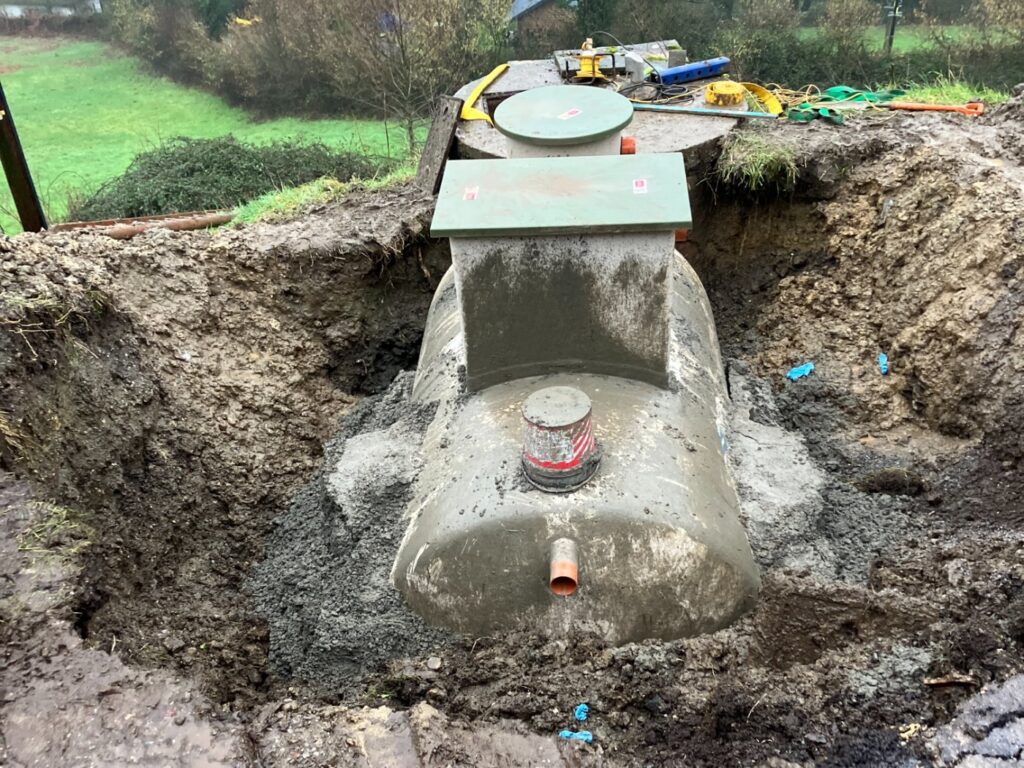
Septic tanks provide an effective wastewater treatment solution for properties not connected to the mains sewer network. These self-contained units break down household waste through biological decomposition before releasing the treated waste into the environment. As septic sewage is discharged into ground or surface water, all systems must comply with Environment Agency regulations to prevent pollution and safeguard public health.
Understanding the General Binding Rules
The General Binding Rules were introduced on 1 January 2015 to simplify the regulation of small sewage discharges from septic tanks and treatment plants. These rules set out the conditions under which operators can discharge wastewater without needing an environmental permit. The operator is the person responsible for the system, whether the property owner, tenant, or another individual with written responsibility for maintenance. Although registration is no longer necessary, operators must ensure their systems comply with all relevant rules to stay lawful.
Discharge to Ground & Surface Water
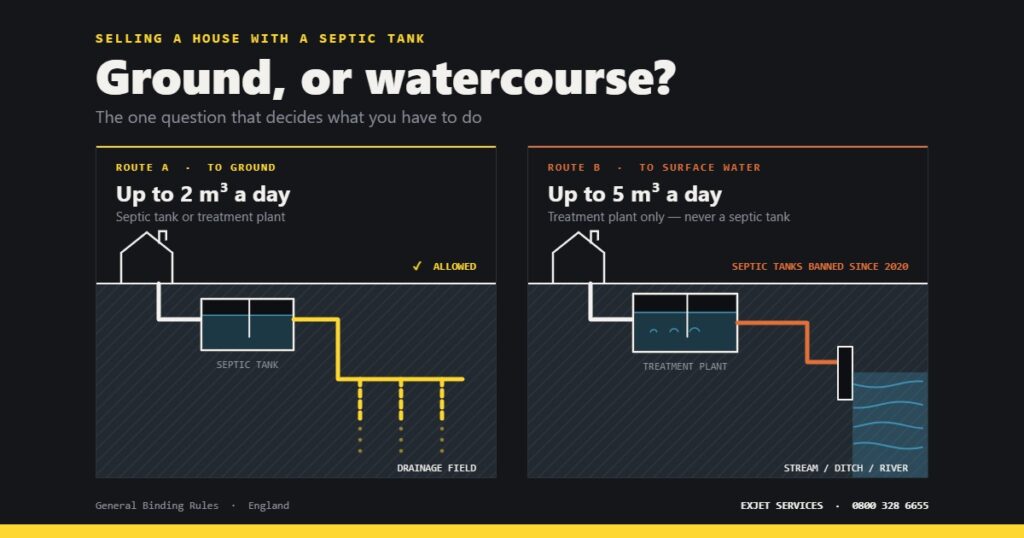
Septic tank discharge methods are classified into two categories. Systems releasing treated waste into the ground do so via a drainage field, also called an infiltration system or soakaway, where it naturally filters through the soil. Under the General Binding Rules, properties may discharge up to 2 cubic metres per day into the ground using either a septic tank or a small sewage treatment plant.
Since 2 October 2023 there is a further condition on new discharges to ground: a drainage field must not be within 50 metres of another exempt small sewage discharge. Discharges to ground are also not permitted in a groundwater source protection zone 1, in ancient woodland, or within 50 metres of a special area of conservation, special protection area, Ramsar wetland site or biological SSSI — an environmental permit is needed instead.
Systems discharging to surface waters, such as rivers, streams, or ditches, are subject to stricter requirements. Properties can discharge up to 5 cubic metres per day to surface waters, but only using a small sewage treatment plant, not a septic tank. Existing septic tanks that discharged to surface waters were required to be replaced or upgraded by 1 January 2020. If you are selling a property with such a system, the requirement passes to the new operator and there must be plans in place to carry out the work within a reasonable timescale — the Environment Agency’s guidance gives this as usually 12 months. The work does not automatically have to be completed before the sale completes; in practice who pays for it, and when it is done, is negotiated between seller and buyer.
Compliance Requirements for Septic Tank Systems
All septic tank systems must comply with the relevant British Standard current at the time of installation and operate according to the manufacturer’s specifications. Maintenance should be performed by a competent person, and waste sludge must be removed by an authorised waste carrier. Sealed septic tank systems, such as cesspits, do not discharge to the environment and therefore do not need to comply with the General Binding Rules, although they must be emptied regularly.
Discharges starting on or after 1 January 2015 require building regulations approval, and planning permission may also be needed depending on the system and the site. A new discharge is not permitted where connection to a public foul sewer is reasonably practicable — the test set by Building Regulations Part H, which puts connection to a public sewer above a treatment plant, a septic tank and a cesspool in that order of preference. A distance of around 30 metres from a public sewer is often quoted as a rule of thumb, but the deciding question is practicability rather than a fixed distance. Discharges in or near designated sensitive areas, including groundwater source protection zones, require an environmental permit from the Environment Agency.
Property Sales & Septic Tank Compliance
When selling a property with a septic tank or treatment plant, the operator must provide written notice to the buyer confirming that a small sewage discharge system is in place. This notice should include a description of the system and its maintenance requirements. Buyers should ensure that the system is in good working order and does not cause pollution. Professional inspections and surveys are recommended to assess the system’s condition and ensure compliance with current regulations.
If a septic tank discharges to surface water, the sale of the property triggers the requirement to upgrade — either to a small sewage treatment plant, or by rerouting the discharge to a drainage field, or by connecting to a public sewer where that is reasonably practicable. As above, what is required is that plans are in place within a reasonable timescale, usually 12 months, rather than the work being finished by completion. Systems must also meet capacity requirements, so extensions or additional connections may require recalculating discharge volumes and potential upgrades.
Septic Tank Services & Compliance Support
Exjet provides septic tank emptying, inspections, and maintenance throughout Devon, Cornwall, Somerset, and Dorset. Our skilled engineers help property owners understand compliance requirements and evaluate system conditions. For properties needing upgrades or new installations, we provide professional advice and solutions customised to each site. CCTV drainage surveys can detect potential problems with existing systems, while our civil engineering expertise supports larger projects, including septic tank to sewer connections where feasible.
If a small sewage discharge does not comply with the General Binding Rules, the Environment Agency will usually offer guidance to address the issue. Failure to comply may lead to enforcement action. For more information on the General Binding Rules, visit the Environment Agency guidance.
Septic Tank FAQs
How do I know if my septic tank is compliant?
You can check whether your system is compliant by looking at where it discharges, how it is maintained and whether it meets the current General Binding Rules. If you are unsure, a professional inspection can help confirm whether any changes are needed.
Do septic tank rules apply to older systems?
Yes, the rules can still apply to older septic tank systems. The age of the tank does not remove the need to meet current discharge regulations. If the system is not compliant, it may need to be upgraded, replaced or connected to a suitable drainage field or treatment system.
What happens if my septic tank does not meet regulations?
If your septic tank does not meet the rules, you may need to upgrade the system or replace it with a sewage treatment plant. In some cases, a new drainage field may also be needed. Acting early can help avoid future problems or delays when selling a property.
Do I need to replace my septic tank before selling my property?
If the system is not compliant, this can affect the sale of the property. Buyers must be told about the septic tank and its condition. In some cases, work may be needed before the sale can go ahead.
How often should a septic tank be emptied?
This depends on the size of the tank, the number of people using it and how much wastewater it receives. In general, regular emptying is important to keep the system working properly and to reduce the risk of blockages or pollution.
What is the difference between a septic tank and a sewage treatment plant?
A septic tank separates solids from wastewater, but it does not treat the waste to the same level as a sewage treatment plant. A sewage treatment plant provides a higher level of treatment and is often needed where a discharge must meet stricter rules.