
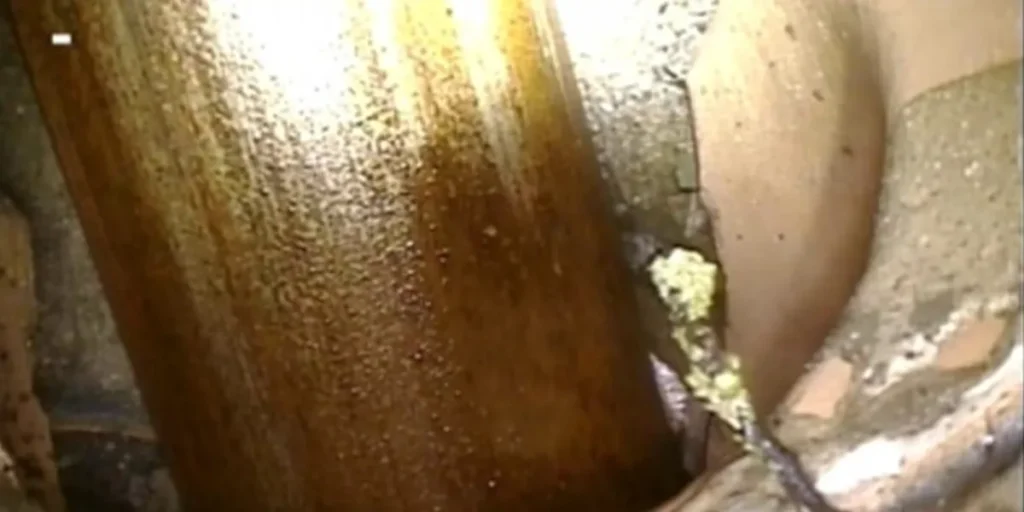
A sewer running beneath a live hospice building had been damaged by a foundation pile installed during construction of a new conservatory. Exjet Services diagnosed the cause, designed a repair around a building that could not close, and completed the work in four weeks without ever restricting access for patients, staff or visitors.
| Client | St Luke’s Hospice, Plymouth |
| Location | Plymouth, Devon |
| Problem | Persistent foul odours at the entrance and conservatory seating area |
| Cause | A foundation pile driven through the foul sewer beneath the floor slab |
| Services used | CCTV drainage survey, hand excavation, uPVC repair, CIPP lining, foamed concrete reinstatement |
| Duration | Four weeks, with the building fully open throughout |
The problem: an odour nobody could trace
Following reports of unpleasant odours around the entrance and conservatory seating area at the hospice, Exjet were contacted by the management to investigate the possible cause. Initial CCTV surveys indicated a defect in the foul water sewer beneath the floor, which was causing a partial blockage in the pipe.
Further investigation revealed the cause: a foundation pile, installed during the building of the new conservatory, had come into contact with the pipe and dislodged it. The pile was seen to penetrate almost the full diameter of the sewer.
Why this was not a straightforward dig
Exjet were asked to propose a repair solution. With only limited visibility from CCTV cameras inside the pipe, the extent of any external collateral damage could not be confirmed. A trial excavation would be needed — but at nearly 3m deep, beneath the floor of an occupied hospice, it could only be done after an engineering review of the floor construction and other structural details, so that the implications for the building were properly understood.
The floor slabs were shown as cast in-situ reinforced concrete, supported on a piled foundation with encastré ring beams. That suggested there could be a void or un-compacted fill beneath the floor slab, making access to the damaged pipe uncertain. The piles were found to be skin-friction bearing and approximately 10m in length, so the top 3–4m would not necessarily contribute to their structural strength.
What the trial hole found
An initial 1m × 1m trial hole was opened, but concerns were raised when 400mm depth of concrete was found rather than the 225mm shown on the drawings. Careful excavation showed the trial hole was clear of the ring beam and that the floor slab had been mass filled. Excavating below this found more mass concrete, believed to be from a previous structure.
With these obstructions, it was not possible to expose the pile and damaged pipe as originally envisaged. The decision was taken to remove the bulk of the suspended slab by cutting out to the nearest edge, and to drive a short heading under the adjacent ring beam to expose the pile from the side rather than from above.
This had not been the preferred method, because of the impact on a nearby planted bed that had to be removed to allow access. Given the frustrations encountered in the initial works, all parties agreed it was the prudent way forward.
The repair
Using our skills at hand excavation in difficult openings, we were able to dig toward the damage and identify the cause. Once revealed, the repair was made quickly using a combination of new uPVC pipe fittings and the installation of a cured-in-place pipe (CIPP) liner between the downstream and upstream manholes.
The void created by the excavation beneath the floor was reinstated with foamed concrete, and the reinforced concrete floor slab reconstructed and dowelled into the surrounding existing slabs. The planted beds were reinstated and the project handed back to the main contractor for replacement of the final finishes.
The outcome
During the four-week construction programme, Exjet maintained unimpeded access to the hospice for patients, staff and visitors at all times, and developed good working relationships with staff and the other stakeholders, who agreed the project had been a success.
Working on a live healthcare site is a large part of what we do. See who we work with, or our drainage services in Plymouth.
Talk to us about a similar problem
Exjet Services has been solving drainage and sewer problems across Devon, Cornwall, Somerset and Dorset since 1986, with commercial and planned work right across the South West. Our engineers are directly employed and we are certified to ISO 9001, ISO 14001 and ISO 45001.
If you have a drainage problem that nobody has been able to diagnose, get in touch or ring 0800 328 6655 — answered any hour.