
If your house was built between about 1950 and the early 1970s, there is a fair chance the drain running out to the road is made of pitch fibre. It looks like nothing much on a survey screen — a dark brown bore, slightly matt, often with an odd sagging profile. It is also the single most common reason a drainage survey on a post-war estate comes back with bad news.
Here is what it is, why it fails, and what can actually be done about it — including the part most homeowners are never told, which is that a good share of the pipe may not be their responsibility at all.
What pitch fibre actually is
Pitch fibre pipe is made from wood cellulose fibre impregnated with coal tar pitch. That is genuinely all it is: compressed wood pulp, soaked in bitumen, formed into a tube.
It arrived in Britain during the post-war housing boom and it solved a real problem. Clayware was heavy, brittle and slow to lay. Pitch fibre was light enough for one man to carry a six-metre length, it cut with a saw, and it joined with simple tapered couplings. On an estate of several hundred houses going up at speed, it was the obvious choice. It was laid in enormous quantities through the 1950s and 60s, mostly as 100mm and 150mm foul and surface water drains.
It was phased out in the early 1970s, once the failures started arriving. The material was expected to last around forty years. Most of what is still in the ground is now sixty to eighty years old.
The four ways it fails
Pitch fibre does not fail like clay or concrete. Clay cracks and fractures; you can see exactly where the problem is. Pitch fibre deforms — it goes soft and loses its shape, usually along a whole length rather than at one point. That difference matters, because it changes what repair is possible.
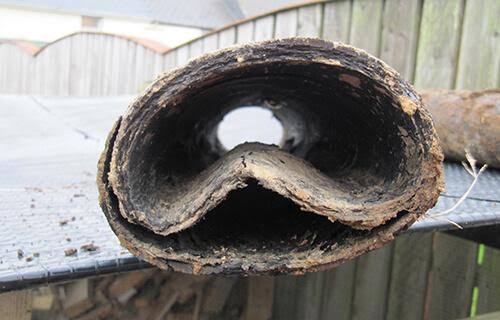
1. Deformation and ovality
The classic one. The pipe slowly loses its circular section under the weight of the ground above and goes oval, squashed from the top. Mild ovality restricts flow and catches debris. Severe ovality reduces the bore so much that the drain blocks repeatedly for no apparent reason — and homeowners often spend years having it jetted before anyone puts a camera down and finds out why.
Ovality is measured as a percentage of the original diameter, and that number decides everything about the repair.
2. Blistering
Blisters are localised swellings of the inner wall, where the pitch has softened and lifted away. They look a little like bubbles in old paint. They form where the pipe has been attacked chemically — and in a domestic drain, the attackers are ordinary household discharges.
- Hot water from washing machines and dishwashers, discharged repeatedly at temperature
- Detergents and degreasers, which soften bitumen
- Fats, oils and grease from the kitchen
A large blister can close most of the bore on its own. It also acts as a snag point, so the drain starts catching wipes, fat and debris that would otherwise pass straight through.
3. Delamination
The pipe wall is built up in layers, and as the pitch degrades those layers separate. The inner surface peels away from the body of the pipe and starts breaking up into the flow. On camera it looks like the drain is shedding its own lining, which is more or less what is happening.
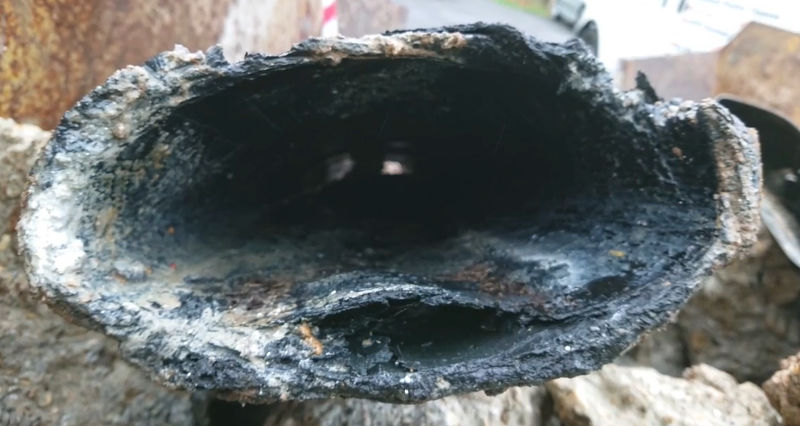
4. Collapse
The end of the road. Once deformation passes a certain point, or delamination has eaten enough of the wall, the pipe loses structural strength and comes in. At that stage there is no lining solution — it is an excavation.
Pitch fibre rarely fails at a point. It fails along a length. That is why patching it usually just moves the problem a metre down the pipe.
How it gets identified
Only by putting a camera in it. Pitch fibre is unmistakable once you have seen it — the bore is dark brown to black, matt rather than glazed, and the joints have a distinctive tapered collar. A survey should record the material, the extent of any deformation as a percentage, and where the blistering and delamination sit along the run.
That last part matters more than it sounds. A repair quote built on “there is pitch fibre in the garden” is guesswork. A repair quote built on a coded survey with measured ovality is a plan. See CCTV drainage surveys and, for buyers mid-purchase, home buyer drainage surveys.
The repair options, and when each one applies
Rerounding and lining — the usual answer
The standard modern solution is to reround the pipe and immediately line it. A rerounding tool is winched through the deformed length and forces it back to a circular section. A cured-in-place liner is then installed straight afterwards, which sets hard and holds the new shape permanently.
The two steps are not optional and the order is not negotiable. Pitch fibre has a memory: reround it and leave it, and it will creep back to oval within weeks. Anyone offering to reround without lining is selling a repair that will not last the year.
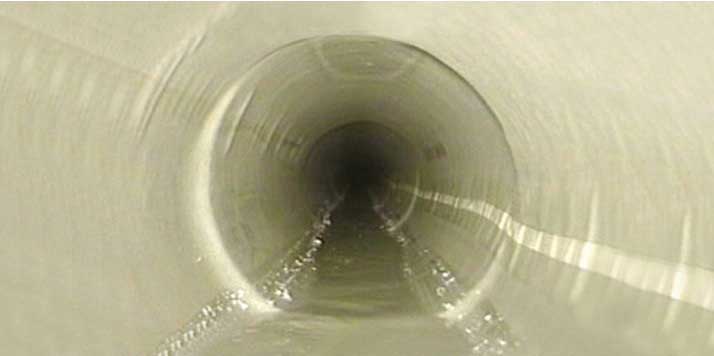
Done properly, the result is a new structural pipe inside the old one, with no excavation and no digging up the drive. See lining repair.
Excavate and replace
Lining has limits. Replacement becomes the right answer where:
- Deformation is too severe to reround without splitting the pipe
- The pipe has already collapsed, or a section is missing
- Joints have displaced far enough that a liner could not seal across them
- The line has to be re-routed anyway, or the gradient is wrong
It is more disruptive and more expensive, but on a badly gone run it is the cheaper option over ten years. See residential drainage repair and civil engineering works.
Patch repair — rarely the right call here
Localised patch lining is excellent for an isolated defect in an otherwise sound pipe. That is exactly what pitch fibre usually is not. Where the whole length has softened, a patch fixes one metre and leaves the rest to carry on deteriorating. Occasionally there is a genuinely isolated defect worth patching — but it should be a decision taken from survey evidence, not a default.
| What the survey shows | Usually the right repair |
|---|---|
| Mild to moderate ovality, pipe otherwise sound | Reround and full-length line |
| Blistering and delamination along the run | Full-length line |
| Severe deformation, or a split on rerounding | Excavate and replace that section |
| Collapse, or missing pipe | Excavate and replace |
| One isolated defect, sound pipe either side | Patch liner — if the rest genuinely is sound |
| Displaced or open joints throughout | Replace, or line depending on severity |
The part most homeowners are never told
Since 1 October 2011, most private sewers and lateral drains in England and Wales that connect to the public sewerage system transferred to the statutory water and sewerage companies. In practice that usually means:
- The drain inside your boundary, serving only your house — still yours
- The lateral drain beyond your boundary, running to the public sewer — usually the water company’s
- A shared sewer serving several properties — usually the water company’s
This matters enormously on post-war estates, because that is precisely where pitch fibre was laid and precisely where drains were built to serve rows of houses. A survey that establishes where the defect sits relative to your boundary can be the difference between a bill for a few thousand pounds and a phone call to the water company.
It is not automatic, the boundaries are not always obvious, and the water company will want evidence. But it is worth establishing before anyone starts quoting for works. Unfamiliar terms are explained in our drainage glossary.
If you are buying a house
Pitch fibre is one of the specific things a drainage survey is for. A standard homebuyer’s survey does not look down the drains, and a solicitor’s searches will not tell you what the pipe is made of.
If the property dates from the 1950s or 60s and has not been re-drained, assume pitch fibre until a camera says otherwise. Finding it before exchange is a negotiating position. Finding it afterwards is a bill.
Talk to Exjet
Exjet Services has been solving drainage and sewer problems across Devon, Cornwall, Somerset and Dorset since 1986, with commercial and planned work right across the South West. We survey, reround, line and replace — which means the recommendation you get is based on what the pipe needs rather than on what we happen to own the kit for. Our engineers are directly employed, and we are certified to ISO 9001, ISO 14001 and ISO 45001.
Related: pitch fibre drain repair. Other services: domestic CCTV surveys, commercial CCTV sewer surveys, lining repair and residential drainage repair.
Ring 0800 328 6655 — answered any hour — or request a quote.