
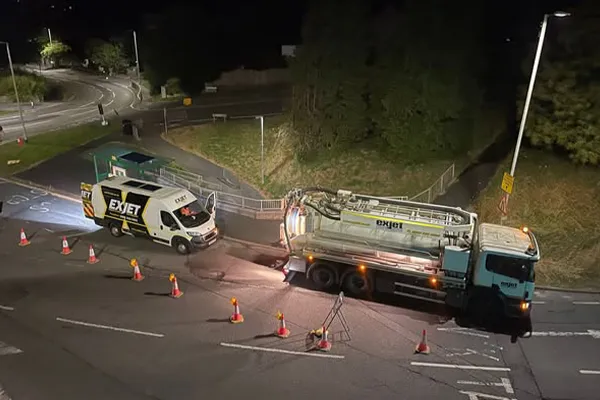
A jet vac crew arrives on site at seven in the morning. The lane closure is already up — installed the previous evening by a traffic management contractor working to a drawing nobody showed the drainage team. It covers the right length of road. It just doesn’t leave anywhere for a 26-tonne tanker to stand within hose reach of the chamber that needs cleaning.
Everyone on site is competent. Everyone has done their own job properly. And nothing is going to happen today.
This is the most common way a highway drainage job loses a day, and it almost never appears as a line on anyone’s invoice. It turns up instead as standing time, a second mobilisation, a permit variation, and a conversation about whose fault it was.
Traffic management for drainage works isn’t generic traffic management
A lane closure is not a lane closure. What the layout actually has to accommodate depends entirely on which discipline is turning up, and the three we run most often need three quite different things.
CCTV surveys move
A survey crew doesn’t work at one point — it works along a run, manhole to manhole, and then moves to the next one. The traffic management either has to cover the whole length from the start, or it has to be designed to be progressed through the shift. Get that wrong and you either close far more road than you needed for far longer than you needed, or you stop every ninety minutes to re-set. See CCTV sewer surveys.
Jet vacs need a footprint, not a gap
A combination unit needs to stand within working reach of the chamber, with room to deploy the reel and space for the crew to work at the rear. It also has to be able to leave site to tip and come back in — which means the closure has to be designed with a vehicle movement in it, not just a static box. A layout that fits the vehicle but traps it is a layout that fails at eleven o’clock. See commercial sewer cleaning.
Civils needs a compound, and pedestrians need managing
An excavation brings plant, spoil, materials and deliveries, and it brings an open hole that people have to be routed safely around for days rather than hours. Footway closures, ramped crossings and diversion routes are part of the works, not an afterthought to them. See civil engineering works.
None of that is exotic. But it is only obvious to somebody who has actually stood on a job doing the work — and a traffic management contractor pricing a drawing has no reason to know which of the three is turning up, or what it needs.
The traffic management isn’t a service delivered to the works. On a live highway it is part of the method statement.
What “cradle to grave” actually means
Greenlight Highways is our sister company and runs out of the same office as Exjet. In practice that means one team takes a highway drainage job from first enquiry to permit closure, and the same programme covers both halves of it:
- Survey and scope. What the works are, where the access points are, and what plant has to reach them.
- Traffic management design. Built around that plant and that sequence, not around a generic length of carriageway.
- Permissions. A Section 50 street works licence where the works involve opening up the highway and the client isn’t a statutory undertaker — which covers most private, developer and estate work. Then the permit or notice under whichever scheme that highway authority operates.
- Notices and liaison. The authority, the emergency services where a closure warrants it, affected residents and businesses, and any other party with an interest.
- Set up, works, reinstatement. Signing, lighting and guarding to Chapter 8 of the Traffic Signs Manual and the Safety at Street Works and Road Works code of practice — the Red Book — then the core works, then the surface put back.
- Shutdown and closure. Equipment off the road and the permit closed out on time, which is the step that quietly generates charges when it slips.
One programme. One set of dates. One method statement covering the closure and the work happening inside it. And when the sequence changes on the day — as it does — the decision is made by people who own both ends of it.
Where the money actually is
Clients tend to compare the two models on the quoted rate, which is the one place the difference is smallest. The gap is almost entirely in the things that don’t get quoted:
| Cost | What causes it under a split supply |
|---|---|
| Standing time | Crew and plant on site, layout wrong or not yet up, nobody able to authorise a change |
| Abortive visit | Job called off, both contractors remobilise on separate days |
| Permit variation | Approved layout doesn’t suit the works; the change has to go back to the authority |
| Overrun charges | Works run past the permitted window because the TM window was set without them |
| Extended occupancy | More road closed for longer than the works needed, which is charged by the day under lane rental where it applies |
| Management time | Somebody on the client’s side coordinating two suppliers and adjudicating between them |
The last one is the one clients underestimate. Under a split supply, the interface risk doesn’t disappear — it transfers to the client, because the client is the only party in contract with both.
One line of accountability
When the traffic management and the works are bought together there is nobody to argue with. There is one risk assessment and one method statement covering the whole operation, written by the people carrying it out. If the layout is wrong, it is our layout and we fix it. If the works overrun, it is our permit.
Exjet works to ISO 9001, ISO 14001 and ISO 45001, all three renewed in September 2026 and held continuously since 2011, and acts as Principal Contractor for CDM where a scheme requires it. Our engineers are directly employed rather than subcontracted, which is what makes an audited management system mean anything once you’re actually on the road.
The accreditation that actually applies
Greenlight holds ISO 9001 and is registered to National Highways Sector Scheme 12D. It is worth knowing what 12D specifically is, because there are four schemes under NHSS 12 and only one of them is about the roads drainage work happens on.
Sector Scheme 12D is the particular application of ISO 9001:2015 for installing, maintaining and removing temporary traffic management on rural and urban roads — defined in the scheme as roads other than motorways and dual carriageways with a speed limit of 50mph or greater, the majority of which, in the scheme’s own words, “will be under the control of a Local Authority.”
That is exactly where highway drainage sits. Not the motorway network — the B-road with a collapsed gully, the estate road with a blocked sewer, the town centre with a culvert under it.
All Greenlight operatives are Lantra trained, to modules M1 to M7 depending on role:
| Module | Role it covers |
|---|---|
| M1 | Mobile works operative |
| M2 | Registered traffic management operative, including temporary traffic signals |
| M3–M5 | Extensions for low-speed dual carriageways, convoy working and multiphase signals |
| M6 | Registered lead — supervisory responsibility on site |
| M7 | Managers and technical officers — layout design and inspection |
The last row is the one that closes the loop on everything above. Under 12D the person who designs the layout is trained and registered under the same scheme as the operatives who install it. In our case they also work for a company that sits in the same office as the drainage crew the layout is being designed for.
The design never crosses a contractual boundary to be interpreted by someone who wasn’t in the conversation.
Who this suits
It is not for everyone. If you already hold a framework with a traffic management provider and your works are predictable, the split model works perfectly well. Where combining the two earns its keep is on:
- Reactive and emergency highway drainage, where there is no time to coordinate two suppliers
- Survey programmes covering multiple streets, where the traffic management has to keep moving with the crew
- Anything with an excavation in a carriageway or footway
- Works for clients without their own highways function — developers, estates, managing agents, private landowners
- Sites where a previous attempt has already failed once for exactly the reasons above
More of our clients are going this way, and the reason they give is rarely the rate. It is that they stop having to run the interface themselves.
Talk to Exjet
Exjet Services has been solving drainage and sewer problems across Devon, Cornwall, Somerset and Dorset since 1986, with commercial and planned work right across the South West. Our engineers are directly employed, and we are certified to ISO 9001, ISO 14001 and ISO 45001.
Related services: traffic management, commercial sewer cleaning, CCTV sewer surveys and civil engineering works. See also who we work with.
Ring 0800 328 6655 — answered any hour — or request a quote.