
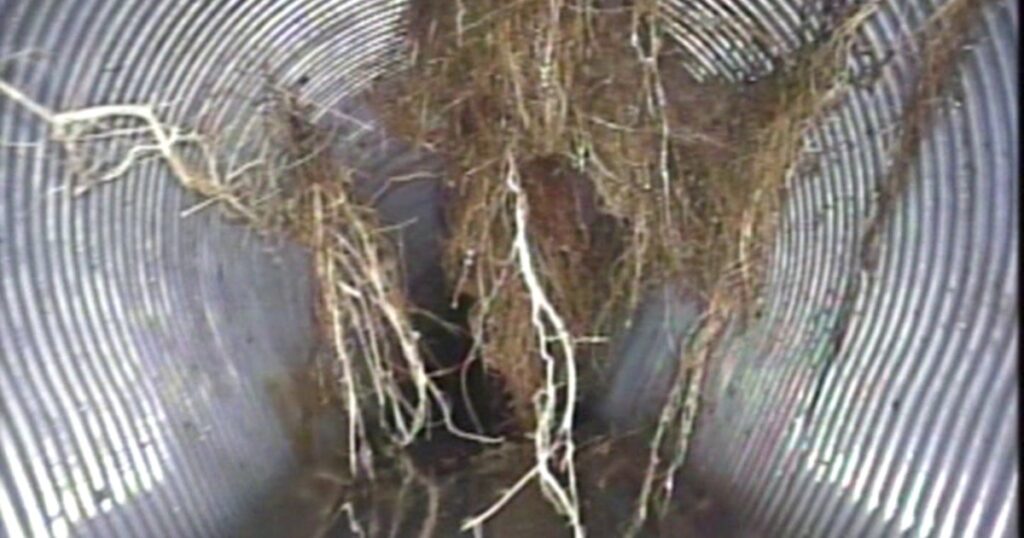
Root ingress is one of the most common things we find on a CCTV survey, and one of the most commonly misunderstood. The usual assumption is that a tree has forced its way through a sound pipe. It almost never has. By the time a root is growing inside a drain, that drain had already failed — the root simply found the opening.
That distinction matters, because it decides whether the repair lasts five months or twenty-five years. This piece covers what causes root ingress, how it is identified, how it is removed, and — the part that gets skipped — how you stop it coming back. The first half is written for homeowners. The second half is for estates, housing providers, contractors and anyone responsible for an adoptable or highway system.
Roots do not break into a sound pipe
The popular picture is of a root sensing water inside a pipe and growing towards it. Arboricultural research does not support that. Roots do not navigate towards distant water. They grow outwards through whatever soil offers moisture, oxygen and nutrients, and they proliferate where conditions happen to be good.
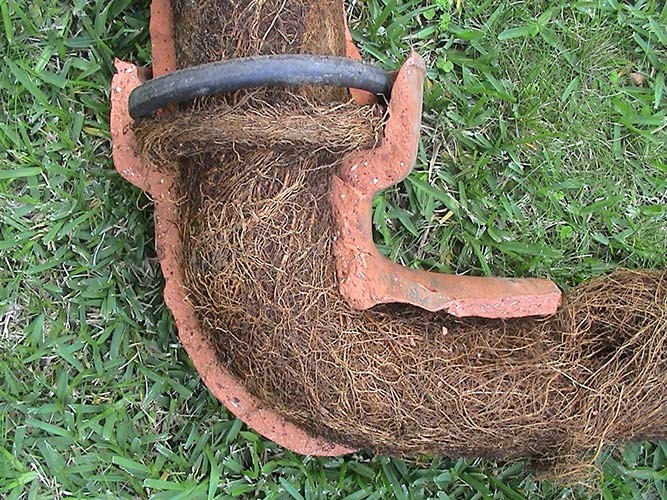
A leaking drain creates exactly those conditions. Water and nutrient-rich effluent escaping from a cracked barrel or an open joint produces a permanently damp, well-fed pocket of soil. Any root that reaches that pocket thrives, thickens, and then exploits the gap it came from. A fine root hair gets through a one-millimetre opening, swells over successive seasons, and in doing so levers the defect wider.
So the sequence runs: defect first, root second. A root mass in a pipe is evidence of a structural problem that was already there. Cut the root out and leave the opening, and you have treated the symptom.
Where roots actually get in
In practice, a handful of weak points account for most of what we see across Devon, Cornwall, Somerset and Dorset.
- Open joints in vitrified clay. Most older drainage in the South West is clayware laid in short lengths. Pre-1970s runs were jointed with mortar or caulked with tarred rope and clay, and those joints shrink, crack and wash out. Every joint is a potential doorway, and a typical domestic run has one every 600mm or so.
- Displaced or open joints after ground movement. Shrinkable clay soils, nearby excavation, heavy vehicle loading over a shallow run, or a washed-out bed will all pull joints apart.
- Pitch fibre. Widely laid between the 1950s and 1970s, it delaminates and deforms into an oval, opening seams and joints as it goes. We have a separate piece on pitch fibre failure and a pitch fibre repair service, because it is common enough locally to warrant both.
- Badly made connections. An intruding or poorly sealed junction where a branch meets the main run is one of the most frequent entry points on any system, old or new.
- Cracked or missing benching in manholes and inspection chambers. Roots get into chambers as readily as into pipes, and a chamber gives them room to build mass.
Species matters less than people expect. Willow, poplar and ash have the worst reputations, but we routinely pull root mass out of drains near laurel hedging, leylandii, buddleia and bramble. Proximity and the presence of a defect matter far more than what is planted.
How to tell you have a root problem
Root ingress has a signature that distinguishes it from fat, wipes or a collapse.
- It recurs in the same place. A blockage that clears, behaves for a few months and then returns to the same chamber is the classic pattern. Fat and debris build where roots have created a snag point.
- It is seasonal. Problems that sharpen in late summer and autumn, when soil is driest and roots are working hardest, point towards roots rather than misuse.
- The drain runs slowly rather than stopping dead. A root mass restricts the bore gradually. You get a slow bath, a gurgle from a downstairs WC, or a gully that takes its time, long before anything backs up.
- Rodding works, but only briefly. Rods push a channel through a root mass without removing it.
Our post on the signs of a partially blocked drain covers the wider symptom picture.
What a CCTV survey tells you that rodding cannot
You cannot plan a root repair without seeing the pipe. A CCTV drainage survey gives you four things that change the decision:
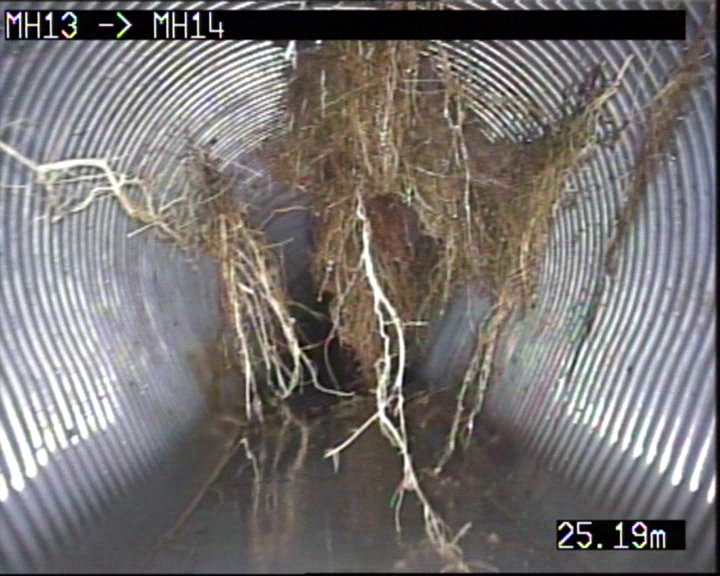
- Where the roots are, to the metre from a known chamber, and at which clock position in the pipe — 12 o’clock is the top of the bore, 6 o’clock the invert.
- How much bore they are taking, recorded as a percentage cross-sectional area loss. This is the difference between a wash-and-watch and an urgent repair.
- The defect they came in through. An open joint, a longitudinal crack, a displaced connection — coded, located and photographed. This is the thing that gets repaired.
- The condition of the rest of the run. There is no point lining three metres of a pipe that is failing along its whole length, and equally no point replacing a run where one patch would do.
Surveys are coded to the Manual of Sewer Condition Classification, the industry standard that lets any competent engineer read a report produced by anyone else. Roots carry the code R, and a competent survey distinguishes between fine roots, root mass and tap roots. That distinction decides the method: fine roots will usually jet out, while a tap root through a displaced joint needs a cutter and, almost always, a patch over the joint afterwards. Our guide to what happens during a drain survey explains the process, and the drainage glossary covers the terminology.
Removing the roots: the four steps, in order
Root removal is an escalation. You start with the least invasive method that will work and step up only when the pipe or the root mass demands it. Going straight to the heaviest option is how pipes get damaged.
| # | Method | When it is used |
|---|---|---|
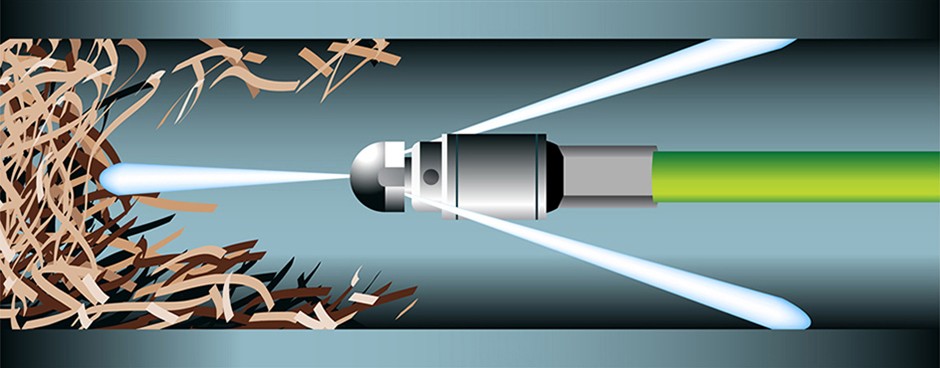
| 1 | High-pressure water jetting with rotary root-cutting heads | The default, and it handles the large majority of root ingress. Specialist rotating heads cut the root mass away from the pipe wall and the jetvac recovers the debris rather than pushing it downstream. |
| 2 | Higher-pressure jetting | Commercial work only, on heavier root mass. Strictly dependent on pipe material and condition — robust materials in known-sound condition. Never on plastic or pitch fibre, and never where the condition of the pipe is unknown. |
| 3 | Robotic cutter | For established, woody root mass that jetting will not shift, and for reinstating connections after lining. Largely a commercial technique. |
| 4 | Excavate and repair | The last resort. Where the pipe is collapsed, deformed beyond lining, or the root has taken the structure with it. |
The pressure used is chosen for the pipe, not for the blockage. Published guidance from WRc and from the plastic pipe industry sets a working ceiling of around 120 to 130 bar for cleaning where pipe material is plastic or pipe condition is unknown or defective, and testing has shown that is enough to clear the blockages plastic pipes realistically suffer. Higher pressures have their place on robust, sound material — and we hold the equipment for it — but putting them into a tired clay run or a pitch fibre drain turns a repairable defect into an excavation. The Water Jetting Association consolidated its guidance into a single Black Code in August 2026, replacing the separate Blue, Red and Purple codes.
Our jetvac services post explains why recovering the arisings matters rather than simply flushing them on.
Cutting roots is not a repair
This is the part that gets left out of a lot of quotes. Cutting roots out of a pipe and leaving the joint open guarantees their return, usually within one or two growing seasons. We see drains that have been cut annually for a decade, each visit charged, with the defect untouched throughout.
Once the pipe is clean, the entry point gets sealed. The options, in increasing scale:
- Patch repair. A short glass fibre and resin patch positioned over the defective joint or crack and cured in place. No excavation, no disruption, and for a single open joint it is usually all that is needed.
- Full-length CIPP lining. A resin-impregnated liner installed through the whole run and cured with hot water, steam or UV. Appropriate where joints have failed along the length rather than at one point. It also seals every joint at once, which is what makes it the durable answer to root ingress.
- Excavation and replacement. Where the pipe has lost its structure. Our civil engineering team handles the dig and reinstatement.
Details of all the no-dig options are on our lining and repair page, and for homes on the residential drainage repair page. Whichever route is taken, the run is re-surveyed afterwards so there is a record that the defect is actually closed.
For homeowners: whose drain is it?
Before you authorise any work, establish who owns the pipe. It is the question that decides who pays, and it catches people out constantly.
On 1 October 2011, privately owned sewers and lateral drains in England and Wales that connected to the public system transferred to the water and sewerage companies. In broad terms:
- A pipe serving only your property and inside your boundary is yours.
- A pipe serving only your property but running outside your boundary is a lateral drain, and is the water company’s.
- Once a pipe picks up a second property it is a sewer from that point on, and generally the water company’s — including where that stretch runs under your own garden.
- On a terrace or a pair of semis, those two tests decide it between them. Your responsibility runs to whichever comes first: the boundary with next door, or the point where your neighbour’s pipe joins yours.
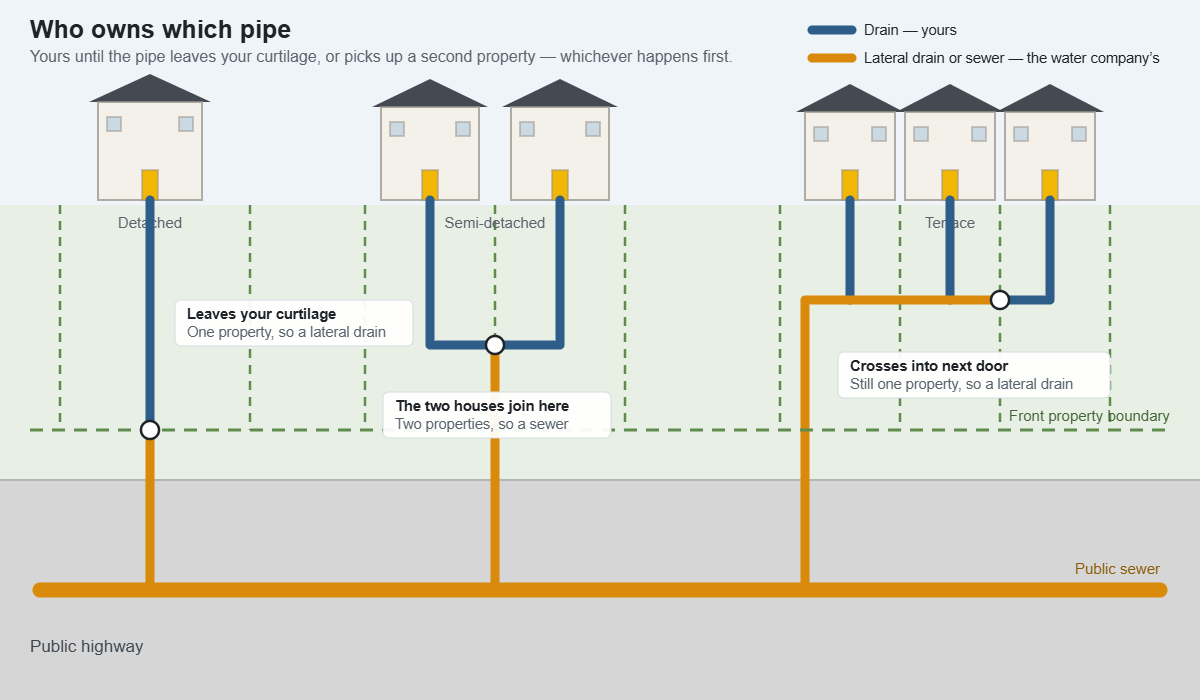
It is well worth establishing this before authorising work. We have set the whole thing out in detail, including the curtilage cases and what riparian ownership of a watercourse or culvert means, in who owns your drain. A survey will show where the run goes and where it joins, which is often enough to settle it. If the defective section turns out to be a public sewer, the repair is a matter for South West Water rather than for you.
If you are buying a property with mature trees close to the line of the drain, a home buyer CCTV survey is the cheapest way to find out what you are taking on.
For estates, housing providers and contractors
On a managed system the economics are different, and root ingress is usually a programme problem rather than an incident.
- Reactive root clearance is the most expensive way to own a drain. A system cleared on failure costs a call-out, often out of hours, plus whatever the failure caused upstream. The same runs cleared on a scheduled visit cost a fraction of that. Planned drainage maintenance exists for precisely this.
- Survey the whole asset once, then target. A baseline CCTV survey across a site identifies which runs have root ingress and which have the defects that will develop it. That turns an open-ended maintenance liability into a priced list of repairs.
- Roots fail adoption. Root ingress, and the open joints behind it, will stop a system being adopted. If you are working towards adoption, it needs to be found and closed out before the authority’s inspection, not after. We carry out sewer adoption surveys to the required standard.
- On the highway, the repair method decides the traffic management. Lining a rooted run is measured in hours under a lane closure; excavating it is measured in days under a full closure with reinstatement to follow. Our post on UV lining for highway drainage sets out the difference.
- Recovery matters on a live system. Cutting root mass and letting it travel downstream simply relocates the blockage, often into a pumping station or an interceptor. Commercial sewer cleaning with combined jetting and vacuum recovery removes the arisings from the system.
What to do if you think you have roots
- Do not keep rodding it. Repeated rodding through a root mass can displace an already weakened joint.
- Get the run surveyed before agreeing to any repair. You want the defect located and coded, not just the blockage cleared.
- Establish ownership if the run leaves your boundary or serves more than one property.
- Ask what happens to the entry point. If a quote covers cutting but not sealing, you are buying the same job again next year.
- Ask for a post-works survey so you have evidence the repair is sound — useful for insurers, buyers and adopting authorities alike.
Exjet Services has been solving drainage and sewer problems across Devon, Cornwall, Somerset and Dorset since 1986, with commercial and planned work right across the South West. Our engineers are directly employed, and we are certified to ISO 9001, ISO 14001 and ISO 45001.
If you have a drain that keeps blocking in the same place, talk to us about a CCTV survey and a no-dig repair before you agree to another clearance. Call 0800 328 6655, use our contact page, or for something blocked right now see emergency drainage help.