
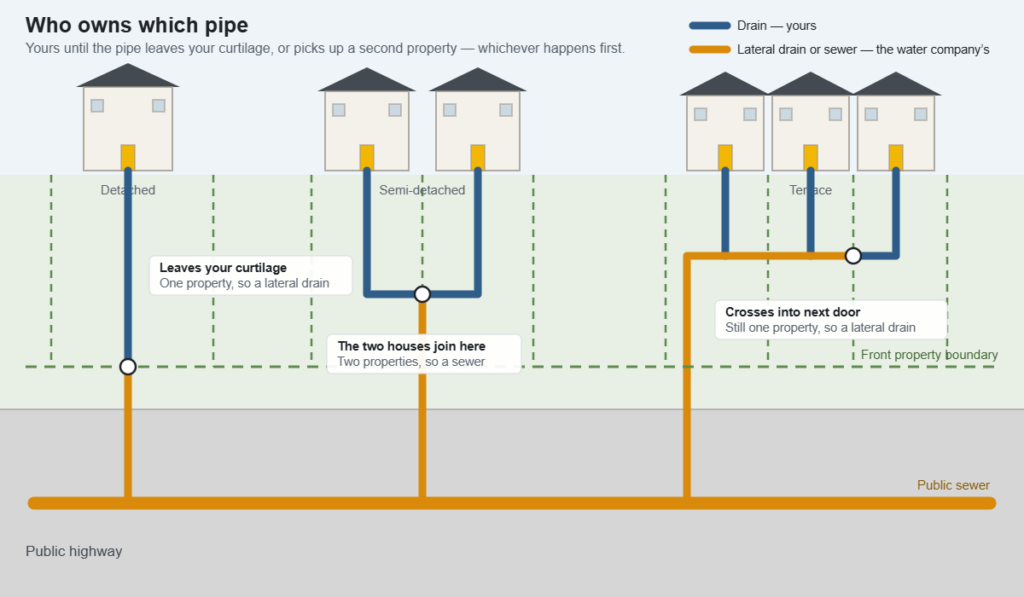
It is the question we are asked more than any other, usually by someone standing over an open chamber with sewage in it: is this mine?
It matters, because the answer decides whether you pay for the repair or your water company does. People get it wrong in both directions. Some pay for work on a pipe that stopped being theirs in 2011. Others wait weeks for a water company to attend a pipe that was never going to be the water company’s problem.
The rules are clearer than their reputation suggests. There are two tests, and a handful of edge cases that catch people out. This is how it actually works in England and Wales.
Three words decide everything
The Water Industry Act 1991 draws a line between three things. Nearly every argument about who pays comes down to which of the three a given length of pipe is.
| Term | What it means | Whose |
|---|---|---|
| Drain | A pipe draining one building, or buildings within the same curtilage. | The property owner’s |
| Lateral drain | The continuation of that drain once it leaves the curtilage, running on to the sewer it connects to. | The water company’s |
| Sewer | Any pipe draining more than one curtilage. It becomes a sewer the moment a second property joins it. | The water company’s |
So there are two tests, and your responsibility ends at whichever is triggered first:
- Does the pipe leave your curtilage? Beyond your own ground it is a lateral drain.
- Does it pick up a second property? From that junction on it is a sewer.
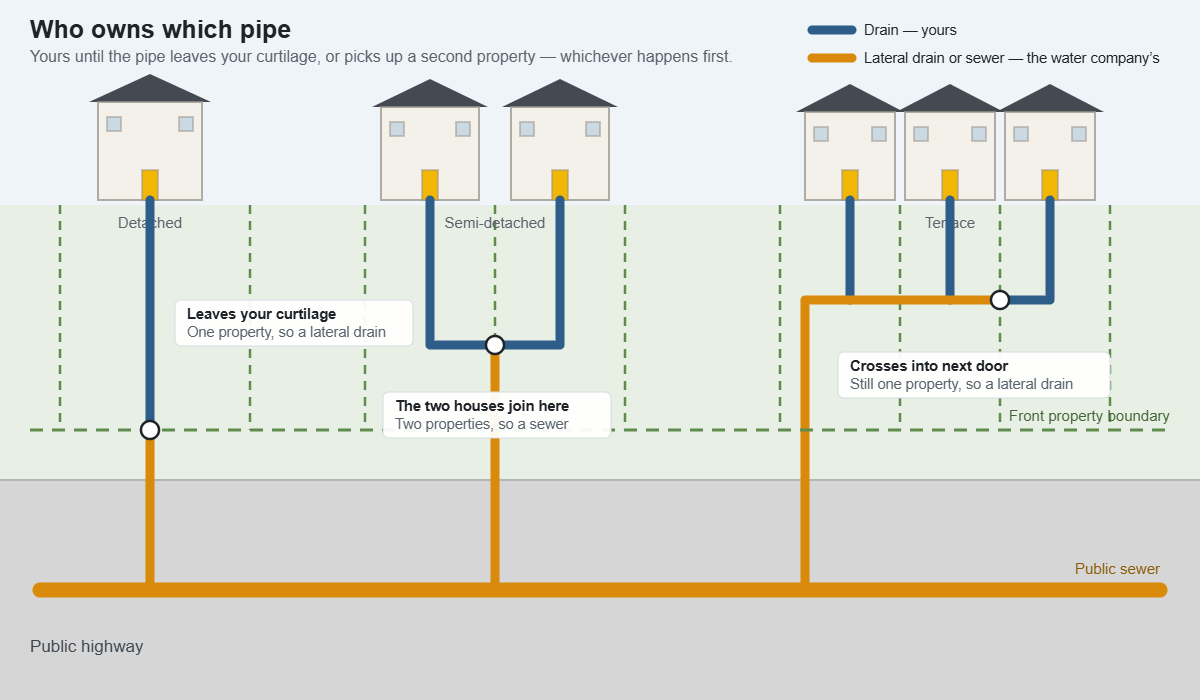
Both tests matter, and in a terrace they often give different answers. Your drain runs rearwards along the back gardens; it crosses the boundary into next door’s garden some distance before it reaches their connection. It stopped being yours at the boundary, not at the junction.
With a pair of semis, where the two drains usually meet on or near the boundary, the two tests tend to land in the same place. That is why people assume the junction is always the dividing line. It is not — the boundary is, whenever the boundary comes first.
What actually happened in 2011
Before 2011 there were tens of thousands of miles of privately owned sewers in England and Wales — shared pipes serving two, ten or fifty houses, with no clear owner and nobody maintaining them. When one failed, the householders it served were jointly liable, which in practice meant nobody paid until a court or an environmental health officer forced the issue.
The Water Industry (Schemes for Adoption of Private Sewers) Regulations 2011 (SI 2011/1566) ended that. Two dates matter, and people routinely confuse them:
- 1 July 2011 — the qualifying date. The question is whether the pipe communicated with a public sewer on that day. This is the date that fixes a pipe’s status.
- 1 October 2011 — the transfer date. The day ownership actually moved to the sewerage undertaker.
Nothing was signed, nobody was asked, and no money changed hands. If your pipe met the test, it simply stopped being yours.
What did not transfer
This is the half that gets forgotten, and in the South West it catches a lot of people.
- Anything not connected to a public sewer. The transfer only caught pipes communicating with the public system. A shared private sewer running to a septic tank or a treatment plant was not connected to anything public, so it stayed private — still shared, still jointly owned, still nobody’s clear responsibility. Across rural Devon and Cornwall there are a great many of these.
- Drains inside your own curtilage serving only your building. Always were yours, still are.
- Private pipes within a single curtilage in common ownership — a school site, a factory, a shopping centre, a farm. One curtilage, so the pipes within it are drains, however extensive the network.
- The internal and communal drainage inside a building. Undertakers did not take on the pipework within a block of flats.
- Sewers already public, and sewers already covered by an adoption declaration before the qualifying date.
Pumping stations ran on a different clock
Private pumping stations were handled separately. The Regulations allowed vesting dates for them up to 1 October 2016, five years behind the pipes they served. The consequence still turns up today: a development can have a pumped system where the rising main transferred in 2011 but the station itself transferred later, or — if it never met the criteria — not at all.
If you manage a site with a private pumping station and you are not certain of its status, that is worth establishing before it fails rather than after.
Curtilage: the word that causes the arguments
Everything above rests on “curtilage”, and the legislation does not define it. Government guidance on the transfer accepts this openly: the legal boundary is one practical basis for deciding where a curtilage lies, but it says plainly that this is not invariably the case.
In most cases the two coincide and nobody argues. Where they come apart, these are the situations we see:
- A farm. The curtilage of the farmhouse is the house with its yard and garden — not the holding. A pipe crossing your own fields has left the curtilage.
- A block of flats. One building is one property, however many households are inside it. The drainage serving that block, within its curtilage, is a drain and the freeholder’s — not twelve separate responsibilities.
- A development of several blocks. Each block has its own curtilage. The pipes running between the blocks therefore serve more than one curtilage, which makes them sewers — a very different answer from a single block, and one that surprises managing agents.
- Sites in common ownership. An industrial estate or a retail park under one owner is treated as one curtilage, so its internal network stays with the site owner no matter how many units it serves.
- Shared drives and flying freeholds. Where the registered title and the ground on the floor disagree, so does everyone else. These are the ones that end up needing a surveyor.
There is also a practical convention worth knowing. Where the sensible access point sits just inside a boundary, guidance accepts that an undertaker may reasonably take responsibility up to the first access chamber within the curtilage, provided it is outside the building and close to the boundary. Water companies apply this with some variation, so it is worth asking rather than assuming.
The rule that surprises people: it is frozen in 2011
A pipe’s status was fixed by the arrangements as they stood on 1 July 2011. Changes since then do not move it.
Split one house into two and the drain you now share does not become a public sewer. Buy next door and knock the two into one and the sewer between them does not revert to you. Whatever the arrangement was on that date is the arrangement that counts, however much the ground has changed since.
Anything built and connected after that date is outside the transfer altogether. New shared drainage is private unless it is formally adopted under a Section 104 agreement, which is a process a developer has to go through deliberately.
Working out who pays, in order
- Find out where the pipe goes. Everything else depends on this, and almost nobody knows it for their own property. A CCTV survey traces the run and shows where it crosses boundaries and where other properties join.
- Ask whether the defect is upstream or downstream of the first trigger. Upstream of your boundary and of any junction, it is yours. Downstream of either, it is not.
- Check it reaches a public sewer at all. If the system discharges to a septic tank or treatment plant, nothing transferred and the shared pipe is still shared.
- Get the sewer records. Your water company holds a public sewer map, though transferred assets are not always well recorded on it — their absence from the map does not prove a pipe is private.
- Put it in writing. A dated survey with a plan is what settles an argument with a water company, an insurer or a neighbour.
If you disagree with the answer
Two different routes, depending on what is in dispute. A disagreement about whether a sewer should have transferred goes to Ofwat. A disagreement about where a curtilage lies is a property question, and goes to the courts or the Upper Tribunal (Lands Chamber).
In practice almost none of this reaches either. A survey showing the layout usually ends the discussion, because once everyone can see where the pipe runs the rules apply themselves.
The other ownership trap: watercourses and culverts
Everything above concerns foul and surface water pipes. There is a second, parallel set of rules covering streams, ditches and culverts — and it catches people out far harder, because the sums are larger and because councils and the Environment Agency increasingly point at the landowner rather than taking the work on themselves.
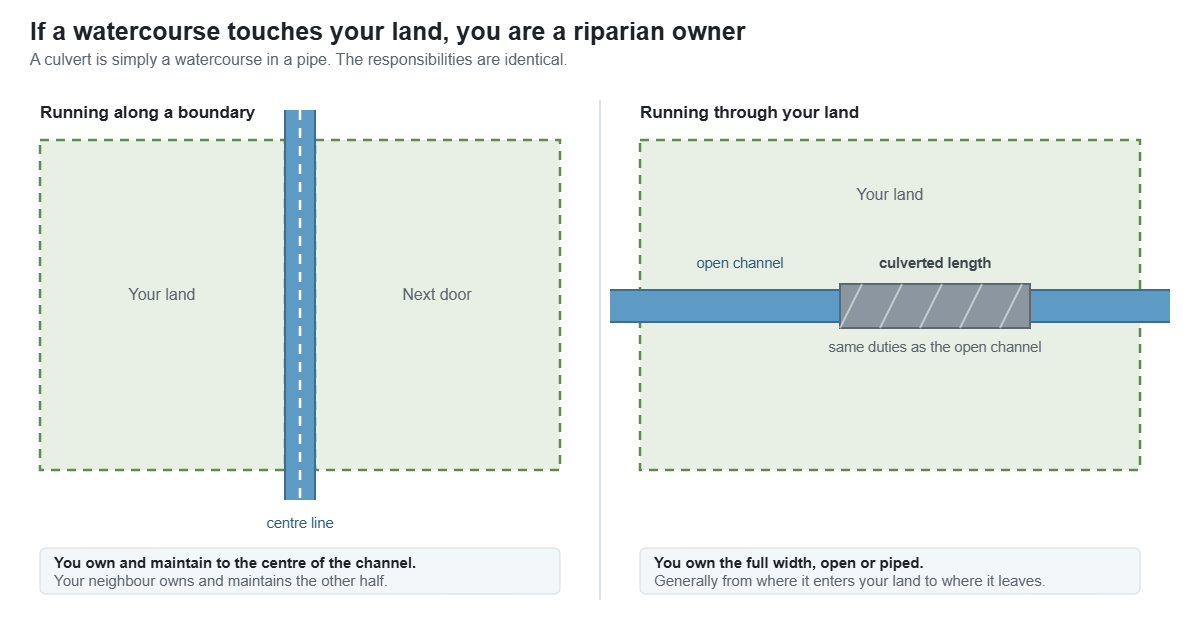
If a watercourse runs along or through your land, you are a riparian owner. You do not opt in, nobody tells you, and it rarely appears in the deeds as a duty. It comes with the ground.
What you own
- Along a boundary — you own to the centre of the channel, and your neighbour owns the other half.
- Through your land — you own the full width, for as long as it is on your land.
- Culverted — exactly the same. Piping it changes nothing. You generally own it from where it enters your land to where it leaves.
Some watercourses, artificial ones especially, belong to somebody else. The deeds should say so, and often do not.
What you have to do
- Let water pass on freely, without obstruction, pollution or diversion.
- Accept flood flow from upstream, even where the channel below you cannot cope. There is no duty on anyone to increase a watercourse’s capacity.
- Maintain the bed and banks, including the trees and shrubs on them, and clear debris and litter — whether or not it came from your land.
- Keep culverts, trash screens and weirs clear.
- Leave the bank clear of development so the channel can be reached.
- Control invasive species such as Japanese knotweed.
Who enforces it
Two regimes, and which applies depends on the classification of the watercourse rather than its size.
| Classification | Authority | Consent under |
|---|---|---|
| Main river | Environment Agency | Water Resources Act 1991 |
| Ordinary watercourse — everything else | Lead local flood authority, or an Internal Drainage Board | Land Drainage Act 1991 |
Main rivers are shown on a published map. Anything not on it is an ordinary watercourse by default, however substantial it looks. In Devon the lead local flood authority is Devon County Council, except in Torbay and Plymouth, which are unitary authorities and act for themselves.
The two provisions that cost money
Section 23 of the Land Drainage Act 1991 requires written consent before you erect or alter a culvert, or put any other obstruction to the flow into an ordinary watercourse. The fee is modest, consent cannot be unreasonably withheld, and if the authority has not decided within two months consent is deemed given. Do the work without it and section 24 treats the result as a nuisance: the authority can serve an abatement notice, prosecute if it is ignored, put the position right itself and recover the cost from you.
Section 25 is the one that arrives unannounced. Where an ordinary watercourse is in a condition such that the proper flow of water is impeded, the authority can serve notice on whoever controls it, or on an owner or occupier of adjoining land, requiring specified works within a set period. Ignore it and you commit an offence — but the fine is rarely the expensive part. The authority can carry out the works itself and recover its reasonable expenses from you. No tender, no competitive quote, no cap, and the bill arrives after the work rather than before it.
There is a right of appeal to a magistrates’ court, and it is time-limited. Once that window closes you cannot raise the same points when they come for the money.
Designation: the one nobody sees coming
Schedule 1 of the Flood and Water Management Act 2010 lets the Environment Agency, a lead local flood authority, a district council or an Internal Drainage Board formally designate a structure or natural feature on your land that affects flood risk — a wall, an embankment, a bank, a culvert. Once it is designated you cannot alter, remove or replace it without consent, and consent can be refused on flood-risk grounds.
Two consequences matter. A designation is registered as a local land charge, so it shows up on searches and follows the property when you sell it. And if you breach it, the authority can serve an enforcement notice, prosecute, carry out the remedial work and recover the cost as a debt. Where an unauthorised change could immediately increase flood risk, it can act first and bill you afterwards.
What to do if this might be you
- Establish whether you have one. Check the deeds, check the main river map, ask the lead local flood authority. Not knowing is not a defence.
- If there is a culvert, find out where it runs and what condition it is in. A CCTV survey is the only way to know, and it costs a fraction of a collapse. Culverts are confined spaces — nobody should be entering one without the training and the kit.
- Never culvert, alter or obstruct a watercourse without written consent first. Retrospective consent is not a thing; it is an abatement notice.
- Keep evidence of maintenance. Dated photographs and survey reports are what you produce when an authority says the condition of the channel is your fault.
- If a notice arrives, act inside the period it states and take advice immediately. The appeal window is short and it closes.
We survey and clear culverts and watercourses across the South West, and our civil engineering team handles the repairs when a survey finds one has failed.
Buying a house? This is the cheapest time to find out
Ownership questions are far cheaper answered before completion than after. A home buyer CCTV survey establishes where the drainage runs, what condition it is in and which parts are going to be yours — including whether you are taking on a shared private sewer that never transferred, or a culvert you will be the riparian owner of. Neither shows up on a standard search.
If there are mature trees near the line of the run, it is also the moment to check for root ingress, which is the most common defect we find on older domestic drainage.
This is general information about how the rules work, not legal advice. Where there is money or a dispute at stake — with a neighbour, an insurer or a water company — take proper advice on your own circumstances.
Exjet Services has been solving drainage and sewer problems across Devon, Cornwall, Somerset and Dorset since 1986, with commercial and planned work right across the South West. Our engineers are directly employed, and we are certified to ISO 9001, ISO 14001 and ISO 45001.
If you need to establish where a drain runs and who is responsible for it, call 0800 328 6655 or use our contact page. For something blocked right now, see emergency drainage help. The drainage glossary explains the terms used above.