
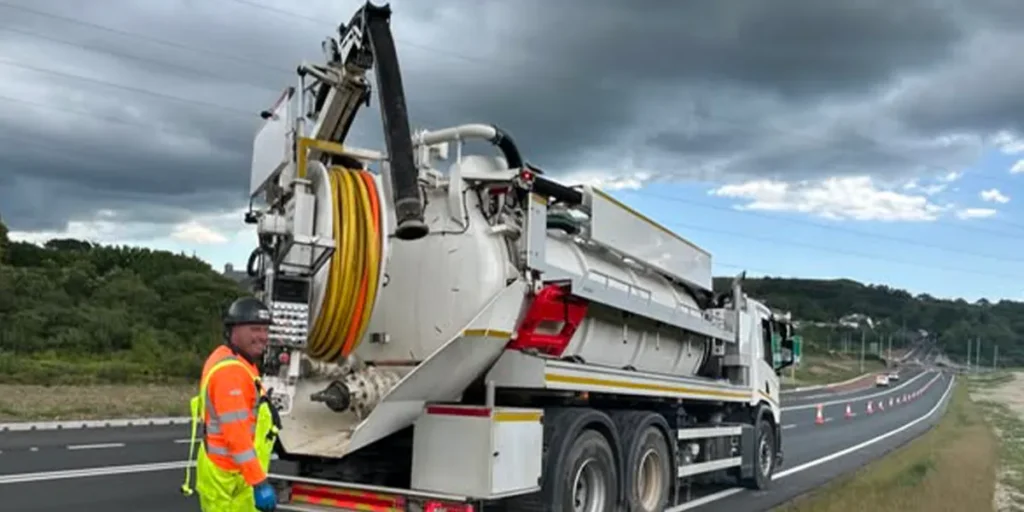
A jetvac is two machines on one chassis: a high-pressure water jetting system and a vacuum tanker. The jet cuts the blockage apart; the vacuum lifts the debris out and takes it away. It is the difference between moving a problem further down the pipe and actually removing it.
Why jetting on its own is only half the job
Jetting a blocked sewer with no recovery pushes the fat, silt and rag downstream. It clears the length you were working on, and quite often it re-blocks somewhere else — frequently on someone else’s property, or at the next change of gradient. The call-out gets repeated a few weeks later and nobody is any better off.
With a jetvac, the jet works back towards the vacuum hose and the material is drawn into the tank as it is released. The line is left clear rather than relocated, and the arisings leave site with the tanker for licensed disposal.
What the jet is doing
Pressure is chosen for the pipe, not for the sake of it. Fat, scale and root are all cut differently, and the jetting head is matched to the job — a rotating head for hard deposits, a de-scaler for encrusted bore, a flat-fronted nozzle where the pipe wall is fragile. Old, brittle clay and pitch-fibre pipework needs the pressure and flow held down rather than turned up. Where the bore has to be cut back to something structural, the same principle applies at the other extreme: on Mayflower Street in Plymouth we ran an abrasive jet at 40,600 psi to cut a steel pile out of a live sewer without damaging the host pipe around it.
Where we use jetvac units
- Blocked drains and sewers — fat, wet wipes, silt, root ingress and the usual foreign objects. See residential blocked drains and commercial sewer cleaning.
- Gullies, catchpits and interceptors — silt and grit that no amount of jetting will shift, because it has nowhere to go until something sucks it out.
- Grease management — kitchens, pubs, hotels and care homes, where the fat load is constant and the schedule matters more than the response time.
- Flood and spill response — standing water and contaminated run-off recovered to tank rather than pushed into a watercourse.
- Tanks, chambers and wet wells — emptied and washed down, often alongside a confined space entry where someone has to go in afterwards.
- Pre-survey cleaning — a silted pipe cannot be coded. Cleaning first is what makes a CCTV sewer survey worth reading.
The waste has to go somewhere
Everything recovered is a controlled waste, and it is Exjet’s duty of care as much as the site’s. Loads go to a permitted facility with the transfer documentation to match, and our ISO 14001 environmental management system is what keeps that consistent rather than case-by-case. If a client is being offered jetting at a price that assumes the arisings simply disappear, it is worth asking where they go. See also tankering.
Reactive is expensive; planned is not
Most of the emergency jetvac work we do is on systems nobody has looked at in years. A kitchen drain on a quarterly clean costs a fraction of the same drain backing up into the servery on a Saturday night, and the second version comes with lost trade and a deep clean on top. If a site has blocked more than once in the same place, the blockage is a symptom — usually a fall, a defect or a fat source — and the fix is a survey, not another jetting visit. See planned drainage maintenance.
Talk to Exjet about your drains
Exjet Services has been solving drainage and sewer problems across Devon, Cornwall, Somerset and Dorset since 1986, with commercial and planned work right across the South West. Our engineers are directly employed, and we are certified to ISO 9001, ISO 14001 and ISO 45001.
Related services: commercial sewer cleaning, residential blocked drains, tankering and planned drainage maintenance.
Blocked now? Ring 0800 328 6655 — answered any hour — or request a quote.