
Most people selling a rural property discover the General Binding Rules the same way: eight weeks into a sale, when the buyer’s solicitor asks a question about the drainage that nobody can answer. The tank has worked fine for thirty years. Nobody has ever needed to think about it. And now it is the thing holding up the sale.
Here is what actually applies, in the order you need to deal with it.
First, find out where it discharges. Everything follows from that.
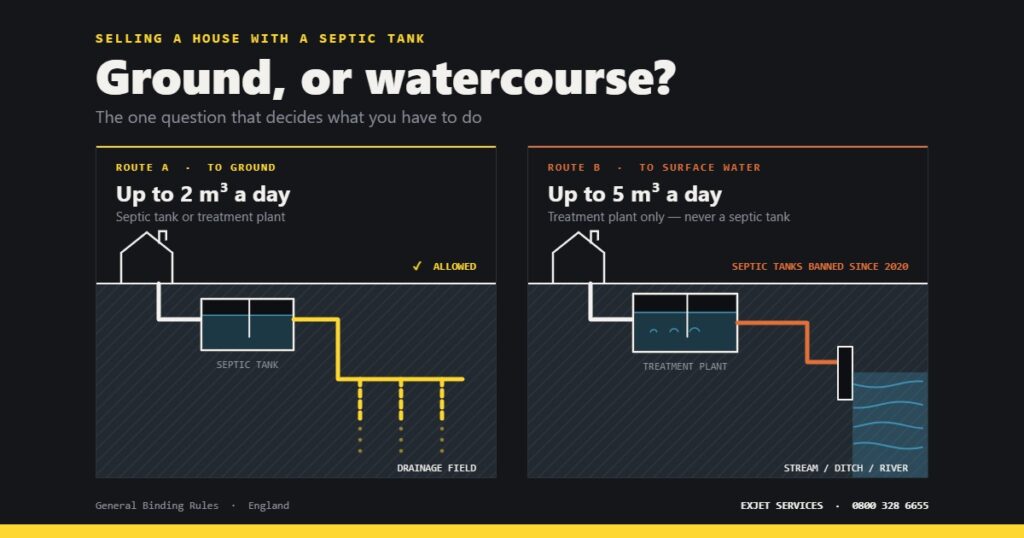
There is really only one question that matters, and it decides how much work you are in for. Does the treated effluent end up in the ground, through a drainage field, or does it end up in a watercourse — a stream, ditch, river or any other surface water?
If you don’t know, you are in the majority. The way to find out is to trace the outfall: follow the pipe from the tank and see where it terminates. A drainage field is a network of perforated pipes in trenches, usually under grass, with no visible discharge point. A surface water discharge has a pipe that comes out somewhere — into a ditch, a bank or a stream — and on a wet day you can often see it running.
| Discharge to ground | Discharge to surface water | |
|---|---|---|
| What it is | Septic tank or treatment plant, into a drainage field | Straight into a stream, ditch or river |
| Daily limit | Up to 2 cubic metres a day | Up to 5 cubic metres a day |
| What is allowed | Either a septic tank or a treatment plant | Treatment plant only — never a septic tank |
| Where that leaves you | Usually no upgrade needed. The job is proving it is compliant and well maintained. | If yours is a septic tank it must be upgraded, or the property connected to a sewer. |
If it discharges to the ground
This is the easier position. You can discharge up to 2 cubic metres a day using either a septic tank or a small sewage treatment plant, provided it goes through a proper drainage field. The system needs to meet BS EN 12566 and the drainage field BS 6297:2007, and it has to be maintained to the manufacturer’s instructions with sludge removed by a registered waste carrier.
There are places you cannot do it at all, and these catch people out:
- Within a groundwater source protection zone 1 — you need a permit instead
- In ancient woodland, or within 50 metres of a special area of conservation, special protection area, Ramsar wetland or biological SSSI
- Within 50 metres of another exempt small sewage disch!rge — this one applies to discharges started after 2 October 2023 and is newer than most of the advice online
- Through a well, a borehole, or a rainwater soakaway installed after December 2007
If it discharges to surface water
A septic tank produces settled sewage, not treated effluent, and putting that into a watercourse has not been acceptable for some years. The deadline for existing systems was 1 January 2020. If yours still does it, the options are to install a small sewage treatment plant, to reroute the discharge to a drainage field, or to connect to a public sewer where that is reasonably practicable — which, under Building Regulations Part H, is the preferred option wherever it can be done.
The part almost everyone gets wrong: the timing
The received wisdom is that if the system is non-compliant, it must be replaced before the sale completes. That is stricter than the rules actually are, and believing it has cost sellers a great deal of money and more than a few sales.
What the Environment Agency’s guidance says is that where a septic tank discharges to surface water and the property is sold, there must be plans in place to do the work within a reasonable timescale, usually 12 months. It does not say the work must be finished before completion.
In practice this is a negotiation, not a deadline. Who pays, and when the work happens, is something you and your buyer agree — often as a price adjustment or a retention.
That matters, because a seller who believes they must install a treatment plant inside a four-week exchange window is a seller who will accept the first quote they are given. A seller who knows the rule is “plans in place, usually within twelve months” has room to get the work priced properly, or to reflect it in the price and let the buyer arrange it.
None of which is legal advice — your conveyancer runs the sale, and the wording that ends up in the contract is theirs. But go into that conversation knowing what the guidance actually says.
What you are legally required to give the buyer
This part is not optional and it applies to every sale of a property with a small sewage discharge, compliant or not. You must tell the new operator, in writing, about the system. The guidance asks for:
| You must provide | In practice |
|---|---|
| A description of the system | Septic tank or treatment plant, make and model if known, capacity, and where it discharges |
| Location of the main parts | Tank, inspection chambers, drainage field or outfall — a simple marked-up plan is ideal |
| The discharge point | Where the treated effluent actually goes |
| Maintenance requirements | How often it needs emptying and servicing |
| The maintenance manual | If you have it. Manufacturers will often supply a replacement |
| Maintenance records | Emptying and service history — the single most useful document you can hand over |
| Details of any changes | Alterations, extensions or repairs made to the system |
If you have been having the tank emptied on a schedule and keeping the paperwork, most of this is already done. If you haven’t, start now — a run of invoices is worth more to a cautious buyer’s solicitor than any assurance you can write.
What actually satisfies a buyer’s solicitor
Conveyancers are not drainage specialists. What they are looking for is evidence that somebody competent has looked at the system and that it isn’t going to become their client’s problem. In practice that means three things: a clear written description, a maintenance history, and — increasingly — an independent inspection.
An inspection is worth doing early rather than late. It will tell you whether the tank is sound, whether the drainage field is working or has silted up, and where the discharge really goes, which is often not where the seller believed. A CCTV drainage survey covers the pipework at the same time, which is the other thing that produces post-completion surprises on rural properties.
Don’t leave it to the last three weeks
The pattern we see repeatedly is that nothing happens until the solicitor’s enquiry arrives, and by then the sale has a timetable. An inspection takes an hour. Getting a system emptied, inspected and documented takes days. Installing a treatment plant takes considerably longer, and needs building regulations approval and a site assessment for the drainage field.
If you are thinking about selling in the next year and the property is not on mains drainage, the cheapest thing you will ever do is find out now which side of that first question you are on.
Talk to Exjet
Exjet Services has been solving drainage and sewer problems across Devon, Cornwall, Somerset and Dorset since 1986, with commercial and planned work right across the South West. Our engineers are directly employed, and we are certified to ISO 9001, ISO 14001 and ISO 45001.
Related services: septic tank installation, tankering and home buyer CCTV surveys. The full detail of the rules is on our septic tank discharge regulations page, and unfamiliar terms are explained in the drainage glossary.
Ring 0800 328 6655 — answered any hour — or request a quote.